

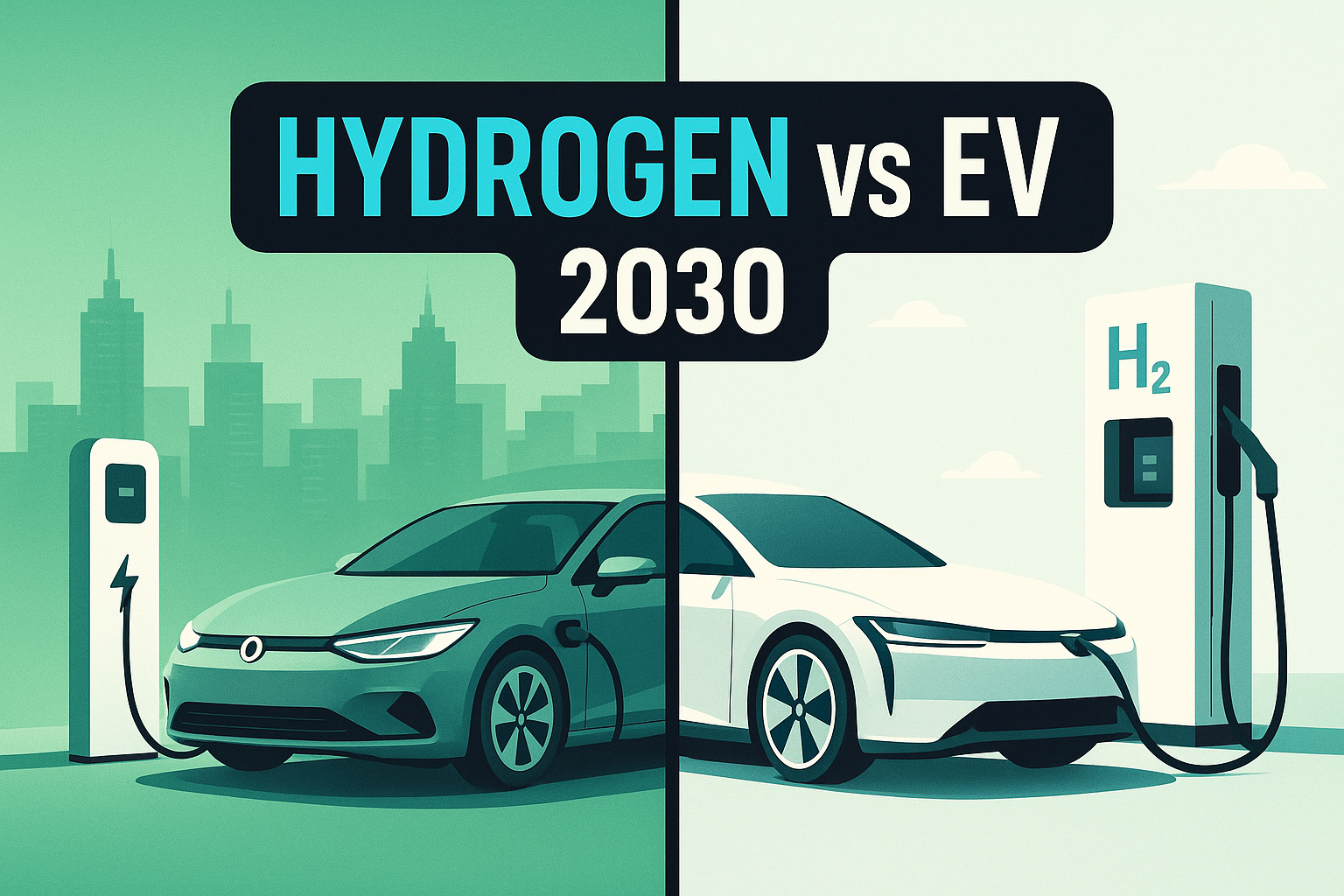
As we move deeper into the 2020s, the debate between hydrogen-powered vehicles and battery-electric vehicles is heating up. With climate change, pollution, and rising fuel costs — many are asking: which green-car technology will dominate by 2030? In this post, we compare hydrogen cars and electric cars across multiple dimensions — environment, range, infrastructure, cost, convenience — and try to forecast which technology is likely to lead the market by 2030.
Table of Contents
- Basics: How Each Technology Works
- Emissions & Environmental Impact
- Driving Range & Refuelling / Recharging
- Energy Efficiency & Running Costs
- Cost & Infrastructure Challenges
- Best Use Cases: Which Vehicle for What Purpose?
- Outlook for 2030: Who Might Win — or Will Both Coexist?
- Conclusion
Basics: How Each Technology Works
Battery Electric Cars (BEVs): These run on electricity stored in lithium-ion (or other advanced) batteries. When you “refuel,” you plug the car into a charging station or home charger. The battery powers an electric motor, propelling the car. BEVs are widely adopted around world. :contentReference[oaicite:2]{index=2}
Hydrogen Fuel-Cell Cars (FCEVs): These store hydrogen in pressurized tanks, and on board, a fuel cell converts hydrogen into electricity (by combining it with oxygen). The generated electricity powers a motor. The only tailpipe emission: water vapor — making FCEVs “zero-emission” at use. :contentReference[oaicite:3]{index=3}
So both are “electric” at the wheels — but their energy-storage approach differs drastically: batteries vs. hydrogen fuel cell + tank.
Emissions & Environmental Impact
On paper, both technologies promise zero tailpipe emissions. FCEVs produce only water vapour and warm air. :contentReference[oaicite:4]{index=4}
But — the full environmental impact depends heavily on how electricity or hydrogen is produced.
- If the electricity charging a BEV comes from renewables (solar, wind, hydro), BEVs are very clean.
- If hydrogen is produced via “green hydrogen” (electrolysis using renewable energy), FCEVs remain eco-friendly. :contentReference[oaicite:5]{index=5}
- However: hydrogen production today often relies on fossil fuels — which undermines its “clean” advantage. :contentReference[oaicite:6]{index=6}
- On BEV side — battery production (mining, manufacturing) has environmental cost; battery disposal/recycling is also a concern. :contentReference[oaicite:7]{index=7}
**Verdict on sustainability:** Neither tech is automatically “green” — it depends on energy sourcing and lifecycle handling. As renewable energy becomes widespread, both BEVs and FCEVs can be environmentally friendly. Right now, BEVs have a head-start because electric grids are already widespread.
Driving Range & Refuelling / Recharging
A critical consideration for users — particularly those driving long distances.
- **BEVs:** Range depends on battery capacity. Typical modern EVs offer a few hundred kilometers per full charge. However, charging takes time — even fast-charging can take 20–40 minutes (for 80% charge), and home charging is much slower. :contentReference[oaicite:8]{index=8}
- **FCEVs:** Hydrogen cars often match or exceed ICE cars’ range, and refuelling is quick — similar to filling petrol/diesel. Reports indicate hydrogen-cars can deliver “full tank” range comparable or better than many EVs. :contentReference[oaicite:9]{index=9}
For people who regularly drive long distances, or value “fill and go” convenience, hydrogen cars have a clear advantage today — IF hydrogen-refueling infrastructure exists where they live. :contentReference[oaicite:10]{index=10}
Energy Efficiency & Running Costs
Efficiency — how much usable energy you get from what you put in — is a big factor for sustainability and cost-efficiency.
- Most BEVs are highly efficient: a high portion of input electricity ends up driving the wheels. :contentReference[oaicite:11]{index=11}
- FCEVs are less efficient overall: converting hydrogen (which must be produced externally) into electricity on board involves energy losses. :contentReference[oaicite:12]{index=12}
- That means — per unit of energy, BEVs often use it more effectively than hydrogen cars.
On running costs, hydrogen fuel tends to be more expensive than electricity (especially off-peak/grid electricity), and hydrogen cars remain more costly to produce — which tends to reflect in higher upfront prices. :contentReference[oaicite:13]{index=13}
So for short-range, city driving, regular commuting, BEVs often remain cheaper and more efficient overall.
Cost & Infrastructure Challenges
Here’s where hydrogen really struggles today (and possibly beyond 2030), because of scale, infrastructure, and economics.
- Hydrogen-fuel production, transportation, storage and fuel-cell manufacturing remain expensive. Fuel-cell stack materials (like platinum) add to cost. :contentReference[oaicite:14]{index=14}
- Hydrogen refuelling stations are very few globally compared to EV charging points. Building a hydrogen infrastructure network requires massive investment. :contentReference[oaicite:15]{index=15}
- BEVs benefit from existing electricity grid — anyone with access to grid or home-charging can charge easily. That widespread infrastructure is already underway globally. :contentReference[oaicite:16]{index=16}
- Battery production and battery-end disposal/recycling remain concerns, but technology (battery recycling, second-life batteries, solid-state batteries) is improving. :contentReference[oaicite:17]{index=17}
Given these facts, hydrogen cars today suffer from “chicken-and-egg” problem: without enough fuel stations demand stays low; without demand, no one builds stations. Breaking that requires large policy & infrastructure push — possible, but expensive and slow.
Best Use Cases: Which Vehicle for What Purpose?
Based on current technology and trends, we can define where BEVs or FCEVs make more sense:
- Urban Commuting / Short Distance / Daily Use / City Driving → BEVs win. Charging at home, zero local emissions, lower running costs, efficient energy use.
- Long-Distance Travel / Frequent Long Drives / Highway / Inter-city Travel → FCEVs have advantage because of quick refueling and strong range. But only if hydrogen infrastructure exists.
- Commercial & Heavy-Duty Transport (Buses, Trucks) → Many experts believe hydrogen may be more suitable here because batteries become heavy and recharging takes time; hydrogen offers better energy density and faster refuels. :contentReference[oaicite:18]{index=18}
Outlook for 2030: Who Might Win — or Will Both Coexist?
By 2030, a few key variables will decide: cost of hydrogen production, expansion of refuelling infrastructure, improvements in fuel-cell efficiency, battery advances, and regulatory push or subsidies by governments.
**Scenarios:**
- Battery Electric Cars will likely remain dominant in personal & urban segment.** The reasons: existing grid infrastructure, steadily improving battery tech, price declines, charging network expansion, and suitability for daily commute.
- Hydrogen Cars may carve niche in long-distance travel, commercial transport (trucks, buses), and regions with supportive hydrogen infrastructure.** If green-hydrogen production scales, and fueling stations become common — hydrogen cars could become realistic for long-haul or heavy-duty use.
- Coexistence model:** It’s possible that by 2030 we see a mixed mobility ecosystem — BEVs for city & daily use, FCEVs for long-range, commercial, and specialty needs (e.g. freight, cold regions, heavy load).
Given current trends and technological trajectory, **BEVs have a head-start** — but hydrogen cars are not irrelevant, especially if green hydrogen and infrastructure get the right push.
Conclusion
The “winner” by 2030 depends a lot on priorities. If you want affordability, convenience, and ready infrastructure — electric cars are the safer bet. If you value long range, quick refueling, and potentially zero-emission long-distance transport (provided green hydrogen), hydrogen cars have their merits.
Realistically, the future may not be about “winner takes all” — but a hybrid scenario where both Battery Electric and Hydrogen Fuel Cell vehicles co-exist, each optimized for different use cases. For individuals in cities — BEVs likely dominate. For long-haul, heavy transport, or eco-conscious regions investing in hydrogen infrastructure, FCEVs could emerge strong.
As 2030 approaches — watch developments in hydrogen production, infrastructure investments, battery innovations, and energy policy. The next 5–10 years will decide which technology becomes mainstream — or whether both become mainstream in different segments.
